
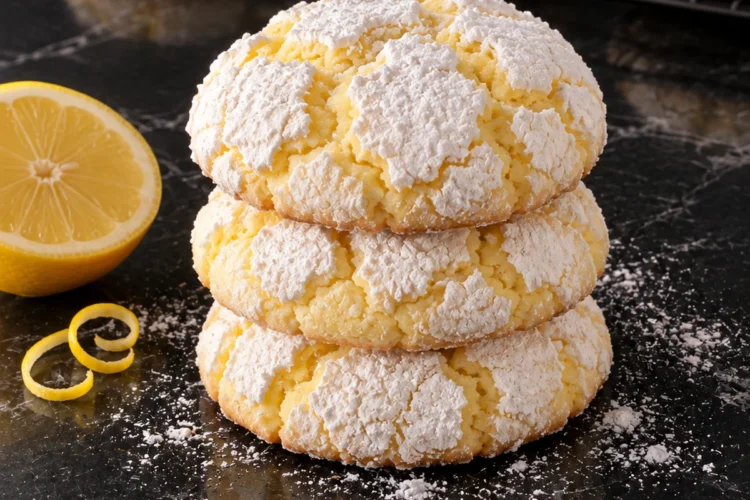

Lemon crinkle cookies are soft and a little chewy inside, pale yellow and bright with fresh lemon, with a thick white coat of powdered sugar that splits into deep cracks as they bake. They taste like a lemon bar in cookie form and look like snow on a tray, which is why they show up in both spring and Christmas cookie boxes.
The flavor comes from 1 tablespoon (6 g) of zest rubbed into the sugar, plus 2 tablespoons (30 ml) of fresh juice. The cracks come from two coats: roll each cold ball in granulated sugar first, then thickly in powdered sugar, so the white stays white in the oven. The dough needs 1 hour in the fridge, then 10 to 12 minutes at 350°F (175°C). One bowl, about 20 minutes of hands-on work, 20 cookies.
At a Glance
- Yield: 20 cookies from 1 1/2 tablespoon (30 g) scoops
- Pan: rimmed half sheet pans lined with parchment, 10 to 12 per sheet
- Time: 20 minutes prep, 1 hour chill, 10 to 12 minutes per sheet
- Difficulty: easy; a hand mixer and one bowl
- Key technique: zest rubbed into the sugar, cold dough, and a granulated sugar coat under the powdered sugar
Where the Cracks Come From
Crinkles form when the outside of the cookie dries and sets before the inside has finished rising. The powdered sugar coat pulls moisture from the surface and dries it into a thin shell. As the soft middle puffs in the oven, that shell splits into islands of white with yellow cookie showing between them.
Powdered sugar on its own often melts into the dough and turns gray or patchy. A quick roll in granulated sugar first, about 1/4 cup (50 g) for the batch, forms a dry barrier, so the powdered sugar stays thick and white. Cold dough matters too: it rises more slowly in the oven, which gives the shell time to set and crack wide.
Lemon, Butter and Flour: What to Know
You need 10 ingredients, all common pantry ones; the card lists the amounts. These four decide how the cookies turn out:
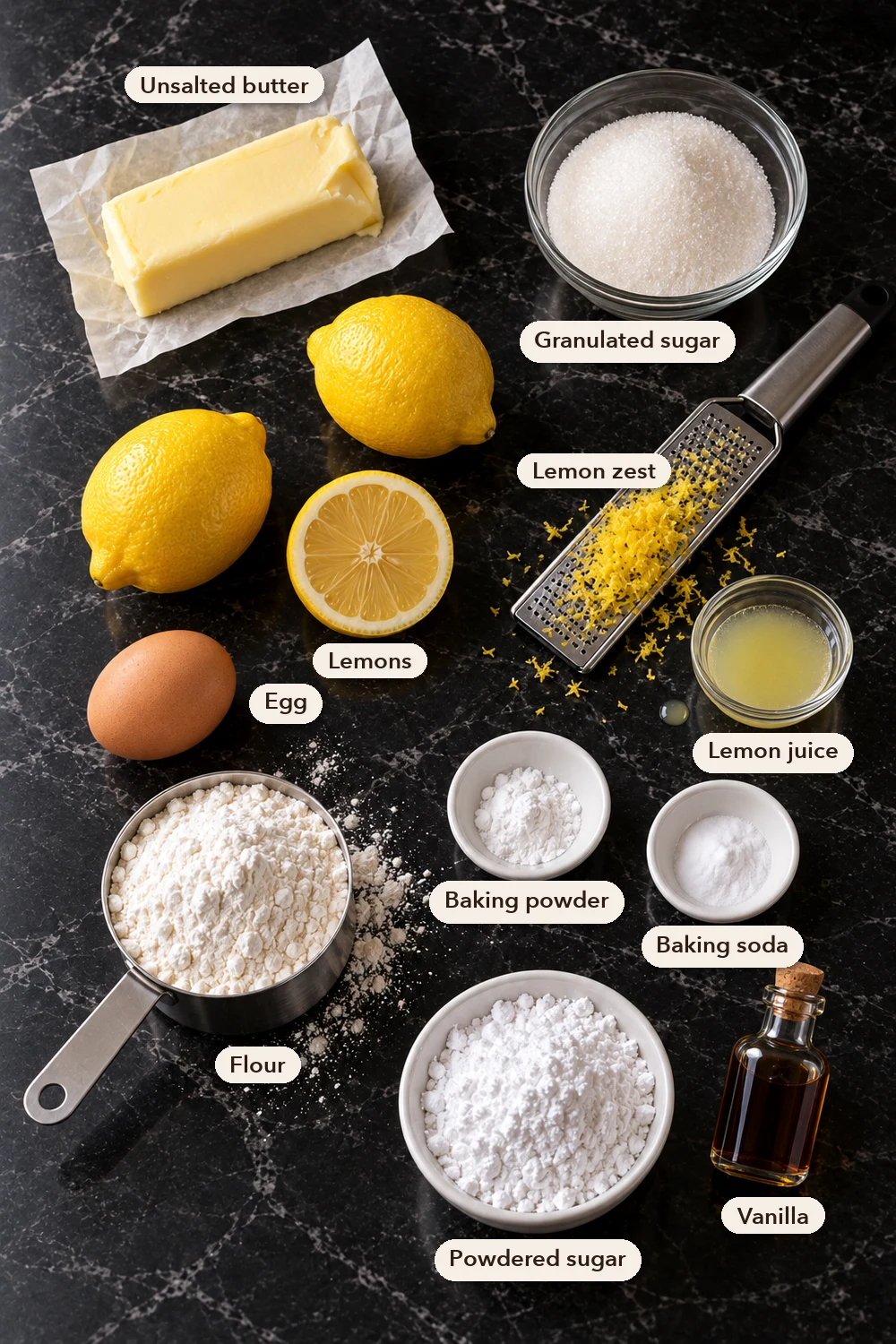
- Lemons: 2 medium lemons give 1 tablespoon (6 g) of finely grated zest and 2 tablespoons (30 ml) of juice. Zest carries most of the lemon flavor; bottled juice alone tastes flat.
- Butter: 1/2 cup (113 g) unsalted, softened to about 65°F (18°C). Melted butter makes the dough too loose to hold the cracks.
- Flour: 1 3/4 cups (220 g) all-purpose, spooned and leveled. Too little and the cookies spread thin; too much and they bake up dry and dome without cracking.
- Powdered sugar: 1/2 cup (60 g) for rolling. Use plain powdered sugar; non-melting decorating sugar looks dull and chalky here.
Making the Dough
Rub the lemon zest into 1 cup (200 g) of granulated sugar with your fingertips for about 1 minute, until the sugar looks damp and pale yellow and smells strongly of lemon. The sugar crystals scrape the oils out of the zest. Beat that lemon sugar with the softened butter on medium for 2 minutes, until fluffy.
Beat in the egg, the lemon juice and 1/2 teaspoon of vanilla. Whisk the flour, 1/2 teaspoon of baking powder, 1/4 teaspoon of baking soda and 1/4 teaspoon of salt, add them and mix on low just until no flour shows. The dough is soft and sticky, like thick frosting, with flecks of zest.
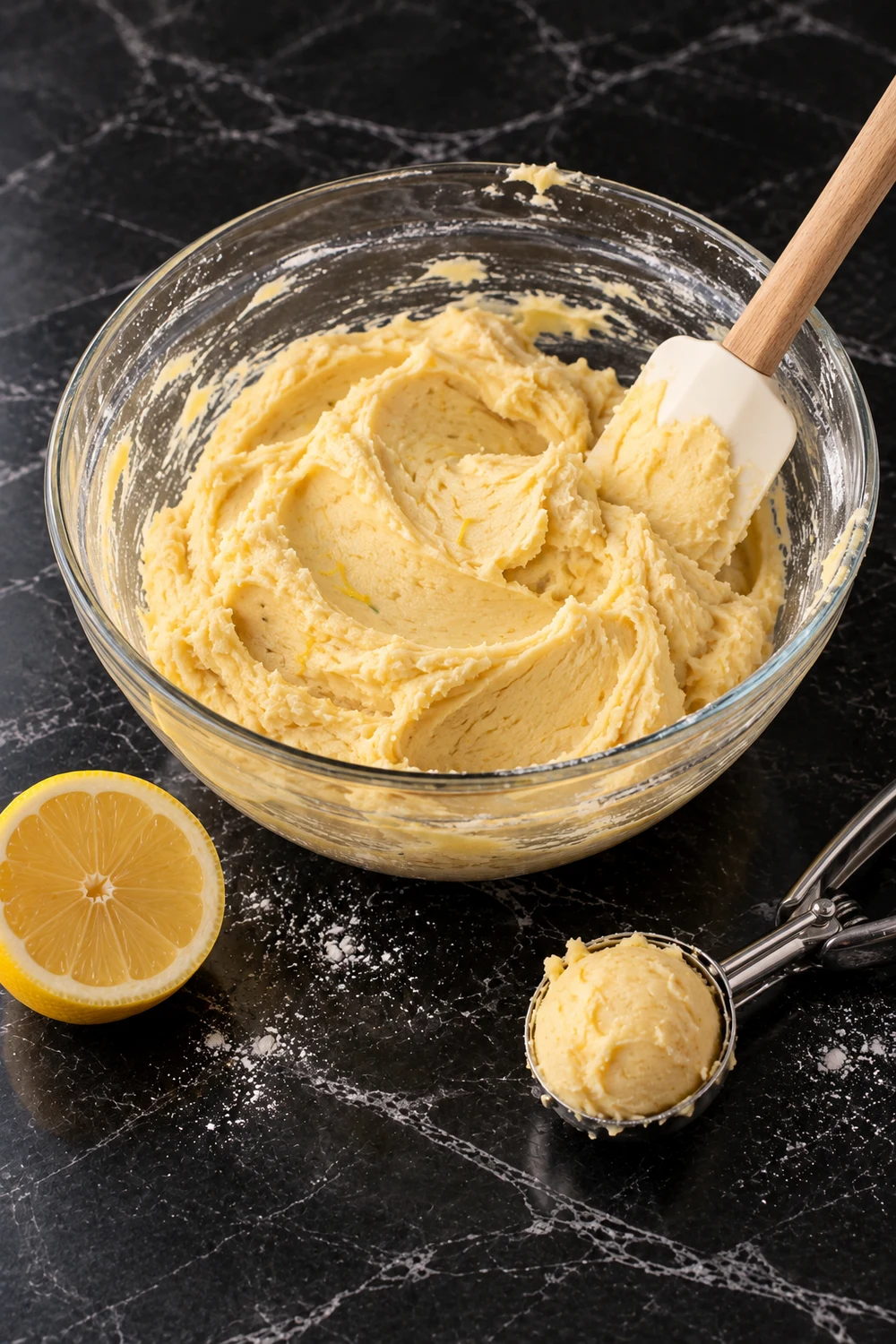
For a deeper yellow, add 1 small drop of yellow gel food coloring with the egg. It is optional; without it the cookies are pale butter yellow.
Chill, Then Two Sugars
Cover the bowl and chill the dough for 1 hour, or up to 2 days. Heat the oven to 350°F (175°C) about 15 minutes before it comes out. Put 1/4 cup (50 g) of granulated sugar and 1/2 cup (60 g) of powdered sugar in two small bowls.
Scoop 1 1/2 tablespoon (30 g) portions and roll them into balls. Roll each ball in the granulated sugar, then drop it in the powdered sugar and roll until it is buried in a thick white coat. Do not tap off the extra.
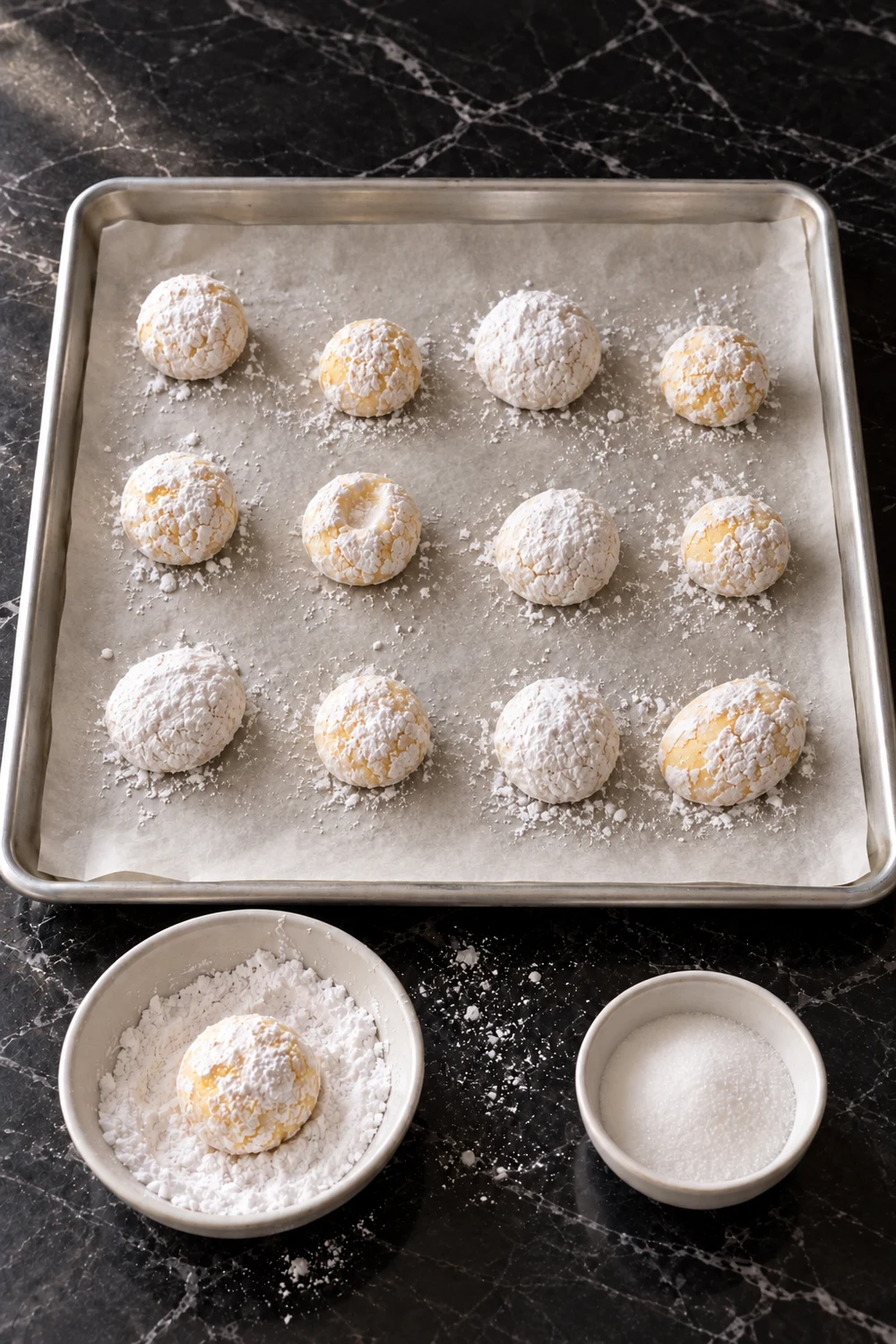
Set them 2 inches (5 cm) apart on parchment-lined sheets and keep the rest of the dough in the fridge while the first sheet bakes.
Baking and Doneness Cues
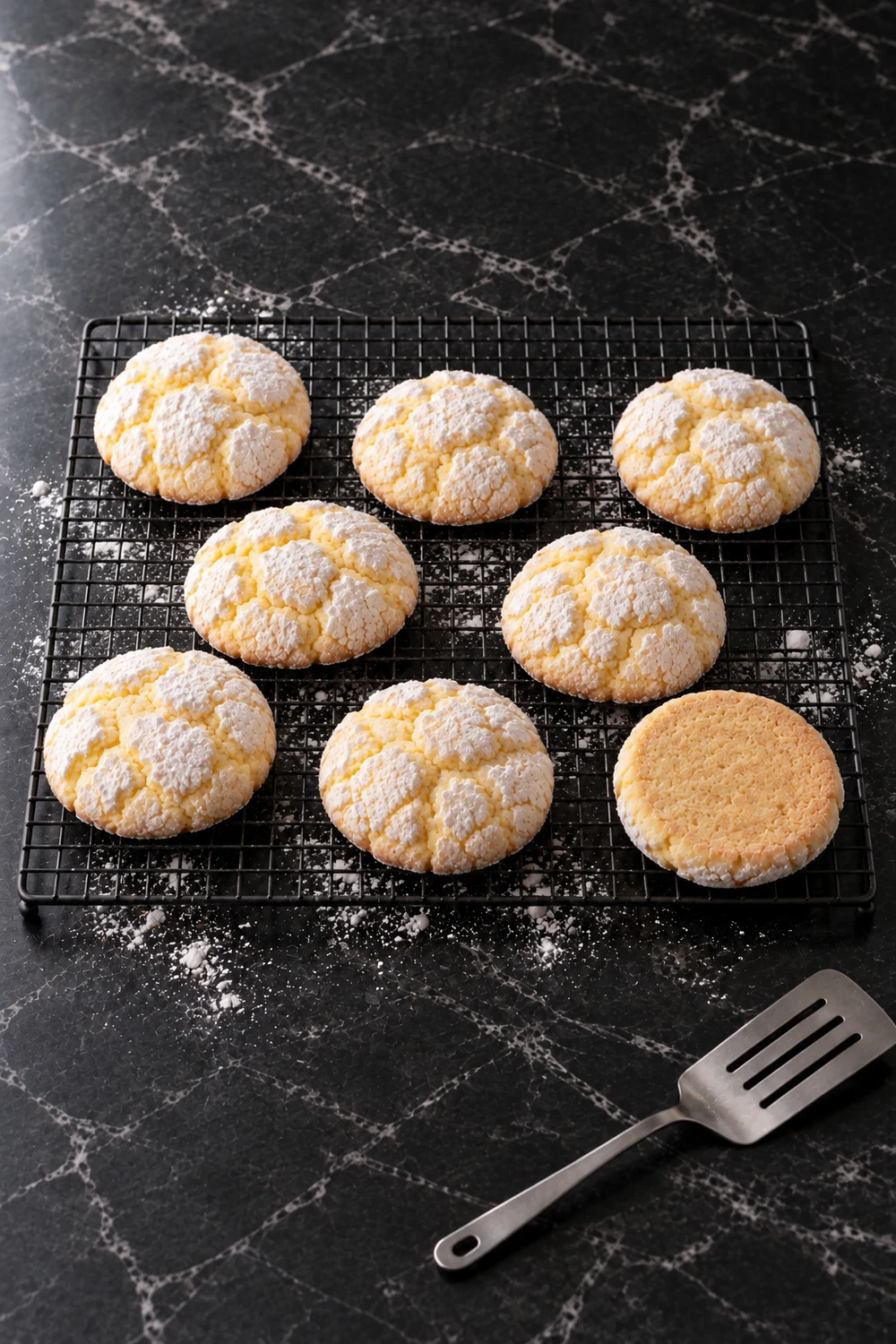
Bake one sheet at a time on the middle rack for 10 to 12 minutes. They are done when the cookies have spread and puffed, the cracks are wide open, the edges are set and the bottoms are pale golden. The centers should still look soft. If the yellow between the cracks starts to brown, they went too long and will be crisp instead of chewy.
Let them rest on the sheet for 5 minutes, then move them to a wire rack. They firm up as they cool. Turn one over to check: a light golden bottom is right.
If Your Crinkles Go Wrong
| What you see | Why | Fix |
|---|---|---|
| No cracks, smooth tops | Warm dough or thin sugar coat | Chill the full hour; roll thickly |
| Gray, melted sugar | Skipped the granulated sugar coat | Roll in granulated sugar first |
| Flat, thin cookies | Butter too soft or flour short | Use 65°F butter; weigh 220 g flour |
| Faint lemon flavor | Juice only, or zest not rubbed in | Rub 1 tablespoon zest into the sugar |
| Dry, cakey middles | Overbaked or packed flour | Pull at 10 minutes; spoon and level |
Swaps and Variations
- Lemon glaze: drizzle with 1/2 cup (60 g) powdered sugar whisked with 1 tablespoon lemon juice.
- Lemon blueberry: fold 1/3 cup (50 g) dried blueberries into the dough.
- Orange: use orange zest and juice in place of lemon.
- Cake mix shortcut: for a 3-ingredient version from a box, try these cake mix crinkle cookies.
The same two-sugar roll makes the white cracks on fudgy chocolate crinkle cookies and chocolate peppermint cookies. For a pink version, strawberry crinkle cookies use freeze-dried berries, and brownie crinkle cookies go fully chocolate.
Make Ahead and Storage
Keep baked cookies in an airtight container at room temperature for up to 4 days. The powdered sugar slowly soaks in after the second day, so the cracks look sharpest in the first 48 hours.
Freeze the unrolled dough balls for up to 3 months. Thaw them in the fridge for 30 minutes, then roll in both sugars and bake, adding 1 minute. Baked cookies freeze for 2 months; dust with a little fresh powdered sugar after thawing.
They round out a cookie box with soft cream cheese cookies. If lemon is your thing, lemon buttercream frosting and lemon ricotta pancakes both lean on plenty of fresh zest too.
Lemon Crinkle Cookie Questions
Why are my crinkle cookies not cracking?
The dough was too warm or the powdered sugar coat too thin. Chill the dough a full hour and roll the balls until they are heavily coated.
Can I use bottled lemon juice?
Yes for the juice, but not for the zest. Fresh zest gives most of the lemon flavor.
Are lemon crinkle cookies good for Christmas?
Yes. The snowy tops fit a holiday tray, and the dough keeps 2 days in the fridge, so you can bake on the day.
Save the Recipe
Pin these lemon crinkle cookies to a cookie board, so the zest-in-sugar step and the two-sugar roll are easy to find next time.

Lemon Crinkle Cookies
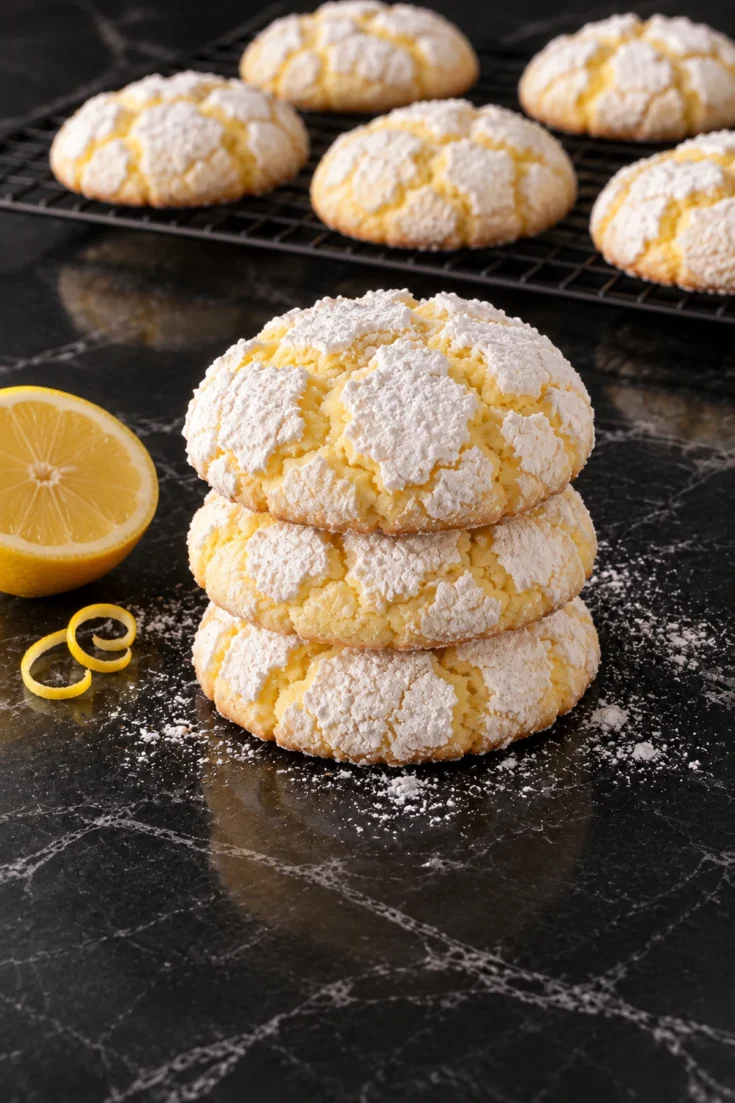
Soft lemon crinkle cookies with a chewy middle, fresh lemon flavor and deep white cracks of powdered sugar. A tablespoon of zest rubbed into the sugar plus 2 tablespoons of fresh juice give real lemon flavor without extract. Chill the soft dough for 1 hour, roll each ball in granulated sugar and then thickly in powdered sugar so the tops stay snowy white, and bake at 350°F for 10 to 12 minutes. One bowl, 20 minutes of prep, 20 cookies that keep 4 days in a tin.
Ingredients
Cookie dough
- 1/2 cup (113 g) unsalted butter, softened
- 1 cup (200 g) granulated sugar
- 1 tablespoon (6 g) finely grated lemon zest (about 2 lemons)
- 1 large egg, room temperature
- 2 tablespoons (30 ml) fresh lemon juice
- 1/2 teaspoon vanilla extract
- 1 3/4 cups (220 g) all-purpose flour
- 1/2 teaspoon baking powder
- 1/4 teaspoon baking soda
- 1/4 teaspoon fine salt
- 1 small drop yellow gel food coloring (optional)
For rolling
- 1/4 cup (50 g) granulated sugar
- 1/2 cup (60 g) powdered sugar
Instructions
- LEMON SUGAR: Rub the lemon zest into 1 cup sugar with your fingertips for 1 minute, until fragrant.
- CREAM: Beat the lemon sugar and softened butter on medium for 2 minutes, until fluffy.
- WET: Beat in the egg, lemon juice and vanilla (and gel coloring, if using).
- DRY: Whisk the flour, baking powder, baking soda and salt. Add and mix on low just until no flour shows.
- CHILL: Cover and refrigerate the dough at least 1 hour. Heat the oven to 350°F (175°C).
- ROLL: Scoop 1 1/2 tablespoon (30 g) balls. Roll each in granulated sugar, then thickly in powdered sugar.
- BAKE: Place 2 inches apart on parchment-lined sheets. Bake 10 to 12 minutes, until cracked and set at the edges with soft centers.
- COOL: Leave on the sheet 5 minutes, then move to a wire rack.
Notes
- Rub the zest into the sugar for 1 minute; it carries most of the lemon flavor.
- Chill the dough at least 1 hour (up to 2 days) so the cookies crack instead of spreading.
- Roll in granulated sugar first, then thickly in powdered sugar, so the tops stay white.
- Done: cracks wide open, edges set, bottoms pale golden, centers still soft. Cool 5 minutes on the sheet.
- Storage: airtight at room temperature 4 days; freeze dough balls 3 months.
Nutrition Information:
Yield:
20Serving Size:
1Amount Per Serving: Calories: 134Total Fat: 5gSaturated Fat: 3gTrans Fat: 0gUnsaturated Fat: 2gCholesterol: 21mgSodium: 60mgCarbohydrates: 21gFiber: 0gSugar: 13gProtein: 2g
